Monday, December 20, 2010

January Not Fiction Book Discussions

We begin our discussions for 2011 with The Fourth Part of the World: The Race for the Ends of the Earth, and the Epic Story of the Map that Gave America Its Name by Toby Lester. In 2003, the Library of Congress bought the only surviving copy of the Waldseemüller world map of 1507, the map that gave America its name, for the unprecedented sum of $10 million. This thrilling historical adventure story provides a microhistory of the making of the map itself and a macrohistory of the Age of Discovery and the evolution of our own contemporary world view.

Maps reflect the world view of the people who create them, and they also serve to shape the world view of those who later use them. Lester says the Waldseemüller map is "the backdrop for something new: a modern epic of Western discovery and manifest destiny in which European explorers, like Odysseus and Alexander and Aeneas before them, wander the known world, roam the high seas, and arrive at unknown shores." However, he says, the map also represents an ancient tradition in which "geography is philosophy--and in which the appearance on a map of the fourth part of the world is a humbling reminder of all that still remains unknown. What the map ultimately charts, in other words, is nothing less than the contours of the human experience itself: the never-ending attempt to imagine a place for ourselves in the world." What can we understand about ourselves as Westerners, as Americans, from learning about this revolutionary map? Can we see its influence in our history? How do we view our world and our place in it today? Is this view changing?

If you are reading the hardcover edition of the book, you can find a select chronology of people, events, and maps in The Fourth Part of the World at the author's website, http://www.tobylester.com/. (The paperback edition includes these references.) You can also view an interactive version of the Waldseemüller map, listen to Lester discuss his book and the images in it, and find a link to a podcast of Lester talking about how America got its name on Public Radio International's This American Life.

According to Chris Anderson, editor in chief of WIRED, "Toby Lester has written a page-turning story of the creation of what amounts to a sixteenth-century Google Earth, a revolutionary way to see the world. It inspired generations of explorers then and will inspire readers now." We hope you will join the discussion: Tuesday, January 4 at 6:30 p.m. at Main Library; Thursday, January 20 at 11:00 a.m. at West Ashley Branch Library; or here on the blog.

Monday, November 29, 2010

Not Fiction Book Discussions List for 2011

We are already looking forward to next year's Not Fiction Book Discussions! We will begin with The Fourth Part of the World: The Race to the Ends of the Earth, and the Epic Story of the Map that Gave America It's Name by Toby Lester, which will set the theme for the 2011 discussions: our understanding of our world, the uses we make of it, our wanderings across it, our settlements on it, our confrontations with the elements and the animals that inhabit it, and our confrontations with each other. You can find the other titles for 2011 on the right side of this page.

And don't forget December's discussions of My Stroke of Insight: A Brain Scientist's Personal Journey by Jill Bolte Taylor: Tuesday, December 7, at 7:00 p.m. at Main Library and Thursday, December 16, at 11:00 a.m. at West Ashley Branch Library.

Happy reading and happy holidays!

Monday, November 22, 2010

December Not Fiction Book Discussions


We end our discussions for 2010 with My Stroke of Insight: A Brain Scientist's Personal Journey by Jill Bolte Taylor, who was named one of Time magazine's 100 Most Influential People in the World in 2008.
On December 10, 1996, Taylor, a 37-year-old Harvard-trained brain scientist, experienced a massive stroke in the logical left hemisphere of her brain that, while she watched and understood what was happening, shut down over the course of four hours, leaving her unable to walk, talk, read, write, or recall any of her life. However, she found herself immersed in the boundless, empathic, euphoric experience of her right brain. After eight years of recovery, Taylor regained her left-brain abilities, but she also learned that she could maintain access to her right-brain abilities.
In this passionate and personal memoir, Taylor explains clearly and scientifically, from the point of view of a neuroanatomist, what it felt like to experience the loss of her left-brain abilities and then recover them, as well as why an immersion in the world of the right brain feels as it does. She also provides a recovery guide for people who have experienced brain injury and their caregivers, including a chapter on What I Needed the Most and a list of Recommendations for Recovery. And for all readers, she offers ways we might "step to the right" to access the sense of well-being provided by right-brain awareness.
Taylor, in her particular kind of stroke and recovery, is truly what Malcolm Gladwell calls an outlier, a person who has succeeded beyond what others have achieved. Regarding her extraordinary experience, she says,
"I have learned so much from this experience with stroke that I actually feel fortunate to have taken this journey. Thanks to this trauma, I have had the chance to witness first-hand a few things about my brain that otherwise I would never have imagined to be true. For these simple insights, I will always be grateful--not just for myself but for the hope these possibilities may bring to how we, as a people, choose to view and nurture our brains and consequently
behave on this planet."
She also offers inspiration for all of us that we might achieve true well-being and happiness similar to hers, confirming Gladwell's thesis that success is a matter of practice and opportunity:
"I believe [Einstein] got it right when he said, 'I must be willing to give up what I am in order to become what I will be.' I learned the hard way that my
ability to be in the world is completely dependent on the integrity of my neurocircuitry. Cell by beautiful cell, circuit by neurocircuit, the consciousness I experience with my brain is the collective awareness established by those marvelous little entities as they weave together the web I call my mind. Thanks to their neural plasticity, their ability to shift and change their connections with other cells, you and I walk the earth with the ability to be flexible in our thinking, adaptable to our environment, and capable of choosing who and how we want to be in the world. Fortunately, how we choose to be today is not predetermined by how we were yesterday."
You can see Taylor speak about her stroke and recovery in a video of her powerful speech (over 1 million views on YouTube!) at a 2008 TED (Technology, Entertainment, Design) Conference:
We hope you will join our conversation: Tuesday, December 7, at 6:30 p.m. at Main Library; Thursday, December 16, at 11:00 a.m. at West Ashley Branch Library; or here on the blog.

Thursday, October 21, 2010

November Not Fiction Book Discussions

With November's book, The Florist's Daughter: A Memoir by Patricia Hampl, we move from a wide-angle cultural consideration of extraordinary success to an intimate portrait of Hampl's parents and an illumination of her assertion that "[n]othing is harder to grasp than a relentlessly modest life."

As Hampl's memoir opens, she is holding her dying mother's hand and at the same time writing her obituary. From this endpoint, Hampl circles back through her childhood in the "blameless middle" of America, St. Paul, Minnesota. She describes her "eternal daughterdom" to her Czech-American father, a florist for the St. Paul elite, and to her Irish-American mother, a library file clerk who loved to tell a tale, revealing her own conflict with the role of daughter and her development as a writer. Hampl asks, "These apparently ordinary people in our ordinary town, living faultlessly ordinary lives, and believing themselves to be ordinary, why do I persist in thinking--knowing--they weren't ordinary at all?" Her honest, tender picture offers an exquisite answer.

We hope you will join the conversation about this "memoir for memoirists to admire" (Kirkus): Tuesday, November 9, at 6:30 p.m. at Main Library; Thursday, November 18, at 11:00 a.m. at West Ashley Branch Library; or here on the blog.

Tuesday, September 21, 2010

October Not Fiction Book Discussions

Our book for the October discussions, Half the Sky: Turning Oppression Into Opportunity for Women Worldwide by Nicholas D. Kristof and Sheryl WuDunn, (also available as a downloadable book) provides an interesting comparison to last month's book, When Everything Changed: The Amazing Journey of American Women from 1960 to the Present by Gail Collins. When we consider how powerful the combination of the right cultural moment, inherited cultural legacies, and the dedicated efforts of individuals was to create greater political and economic equality for American women in the 1960s, we naturally question whether this success might be possible for women elsewhere in the world.

In his book Outliers: The Story of Success, Malcolm Gladwell argues, "Because we so profoundly personalize success, we miss opportunities to lift others onto the top rung. We make rules that frustrate achievement. We prematurely write off people as failures. We are too much in awe of those who succeed and far too dismissive of those who fail. And, most of all, we become much too passive. We overlook just how large a role we all play--and by "we" I mean society--in determining who makes it and who doesn't." In Half the Sky, Kristof and WuDunn issue a passionate call to readers to acknowledge that "in this century, the paramount moral challenge will be the struggle for gender equality around the world" and to learn what they can do to help. They document the enormity of the problems facing women living in poverty and oppression in Africa and Asia, many of them the result of the beliefs their cultures hold about women, focusing on sex trafficking and forced prostitution, gender-based violence such as honor killings and mass rape, and maternal mortality. They honestly explore the complexities of solving these problems. Yet they ask readers to keep in mind that "Women aren't the problem but the solution. The plight of girls is no more a tragedy than an opportunity." With stories of extraordinary people--both the women living in poverty and oppression and those who would like to help them--they illustrate the great potential in empowering women politically and economically.

The title of the book comes from a Chinese proverb: "Women hold up half the sky." Kristof and WuDunn, like Gladwell, believe that we must hold up women so that they can fully inhabit this role. They say, "let us be clear about this up front: We hope to recruit you to join an incipient movement to emancipate women and fight global poverty by unlocking women's power as economic catalysts." In a final chapter they outline what readers can do--right now--to improve the lives of women, and they offer an appendix of organizations through which we can become involved in supporting women. So while this is a difficult book to read, it is also meant to be a practical and an inspiring one. In our discussions, we will consider how hopeful we feel about the initiatives Kristof and WuDunn describe and share stories of the ways we have become--or would like to become--involved.

We hope you will join the conversation: Tuesday, October 5, at 6:30 p.m. at Main Library; Thursday, October 21, at 11:00 a.m. at West Ashley Branch Library; or here on the blog.

Monday, August 23, 2010

September Not Fiction Book Discussions

We continue our consideration of the theme of outliers, those people whose achievements exceed those of their peers, with When Everything Changed:The Amazing Journey of American Women from 1960 to the Present by Gail Collins.

Collins is herself an outlier--she was the first woman to hold the position of editorial page editor for the New York Times from 2001-2007. In the clear, humorous style with which she writes her current column for the Times' op-ed page, Collins describes the radical change in the lives of American women between 1960, when female doctors, lawyers, and engineers were rare and women needed their fathers' or husbands' permission to sign a lease or obtain credit, and Hillary Clinton's historic 2008 presidential campaign.

Using both statistics and oral history, Collins vividly depicts a rapidly changing world that young women today would not recognize. Malcolm Gladwell argues in Outliers: The Story of Success that outliers "are invariably the beneficiaries of hidden advantages and extraordinary opportunities that allow them to learn and work hard and make sense of the world in ways others cannot. The culture we belong to and the legacies passed down by our forebears shape the patterns of our achievement in ways we cannot begin to imagine." In our discussions, we will talk about what these advantages and opportunities were for American women, and what was fortuitous about the particular cultural moment of the 1960s.

We hope you will join the conversation: Tuesday, September 7, at 6:30 p.m. at Main Library; Thursday, September 23, at 11:00 a.m. at West Ashley Branch Library; or here on the blog.

And take a look at our book for October, Half the Sky: Turning Oppression Into Opportunity for Women Worldwide by Nicholas Kristof and Sheryl WuDunn (also available as a downloadable audio book), an inspiring companion read to When Everything Changed. Kristof and WuDunn explore how we can help women in African and Asia rise out of poverty and oppression to make remarkable contributions to their communities.

Friday, July 23, 2010

August Not Fiction Book Discussions

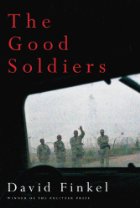
From a scholarly analysis and overview of the American Civil War, we move to an unmitigated on-the-ground account of the Iraq War--The Good Soldiers by Pulitzer Prize-winning Washington Post journalist David Finkel.

Between January 2007 and June 2008, Finkel spent eight months with the United States Army soldiers of the 2-16 Infantry Battalion in Iraq as they took part in the campaign know as "the surge." What is the true story of the surge? And was it really a success? These are the questions Finkel's unflinching third-person narrative poses to its readers as it follows Lieutenant Colonel Ralph Kauzlarich and the men and women in his charge through the violence, tension, and loss of armed conflict and its aftermath. Finkel writes, "my intent was to document their corner of the war, without agenda. This book, then, is that corner, unshaded." Can it be argued that even if the conflict these soldiers were involved in was impossible to win, the soldiers who fought in it can be seen as successful?

Finkel's premise is that the lives of these good soldiers are intrinsically valuable, that their valor in facing and surviving this war is remarkable. He shows rather than tells readers what Drew Gilpin Faust calls, in This Republic of Suffering: Death and the American Civil War, "the work of death," evoking the same questions and contradictions Faust argues were raised by the American Civil War: "the venerable problem of theodicy--of how and why God permits evil" (188); the "problem of the one and the many . . . How could the meaning of so many deaths be understood? And conversely, how could an individual's death continue to matter amid the loss of so many?" (262); and the resulting paradox of "[s]entimentality and irony [which] grew side by side in Americans' war-born consciousness" (264).

Many reviewers have written that The Good Soldiers will take its place as a classic story of war for all times. What do you think? We invite you to join the discussion: Tuesday, August 3, at 6:30 p.m. at Main Library; Thursday, August 19, at 11:00 a.m. at West Ashley Branch Library; or here on the blog.