Monday, June 25, 2012

July Not Fiction Book Discussions

With The Hare with Amber Eyes: A Hidden Inheritance by Edmund de Waal, we move beyond traditional biography and memoir to what many reviewers have called a new or hybrid genre.

When de Waal, a master potter, inherited a collection of 264 netsuke, exquisite walnut-sized Japanese sculptures made to be toggles for kimono, he wanted to learn the history of these objects and how they came to be in his family. His search took him back to Charles Ephrussi, a contemporary of Marcel Proust and one of the models for Swann in A la Recherche du Temps Perdue, who gave the netsuke to de Waal's great-great grandfather as a wedding gift. De Waal followed the story from Paris to Vienna, through the Anschluss and the Second World War, where the netsuke, virtually all that remained of his family and the glittering world they had known, were saved by a woman known today only as Anna.

The resulting book has been described as a memoir, a history, a family history and a biography of the netsuke themselves. De Waal says on his website that "It all started with the netsuke. I wanted to discover the places where these objects had been, how they were handled, who held them. So this is in many ways a history of touch, a history of objects. Objects need biography--there aren't many books out there that take objects themselves seriously. Of course, it was also a personal quest for me to try to work out what I could about my family and their story. I wanted to find out why I grew up not knowing this story. That's perhaps why it's been described as completely cross-genre, because I had no template for it when I began. I envisaged it initially as something quite dry and academic, but I could never have foreseen the way it took shape."

De Waal's acute awareness of his own relationship to the events of his story also sets this memoir apart. He thought to himself as he began his project, "I don't really want to get into the sepia saga business, writing up some elegiac Mitteleuropa narrative of loss. . . . I'm not entitled to nostalgia about all that lost wealth and glamour from a century ago. . . . Melancholy, I think, is a sort of default vagueness, a get-out clause, a smothering lack of focus. And this netsuke is a small, tough explosion of exactitude. It deserves this kind of exactitude in return."

De Waal's book became a meditation on the hidden life of objects and all that they bring with them from one owner to the next. He says, "How objects are handed on is all about story-telling. . . . [and] There is no easy story in legacy." He wanted to know, "What is being passed on to me with all these small Japanese objects?"  What do your favorite possessions say to you and about you, and what conclusions do you think would be drawn if one of your descendants investigated you in this way?

We hope you will join the discussion: Tuesday, July 10, at 6:30 p.m. at Main Library; Thursday, July 19, at 11:00 a.m. West Ashley Branch Library; and here on the blog.

View the Edmund de Waal Netsuke Gallery.

Wednesday, May 16, 2012

June Not Fiction Book Discussions

As we noted in last month's discussion of Blood, Bones & Butter by Gabrielle Hamilton, a challenge for every writer of memoir is to determine which details from one's life to include and which to leave out, which contribute to a clear narrative and theme, and which do not, as well as how to find an engaged but dispassionate perspective on the events of one's life. With Townie: A Memoir by Andre Dubus III, we will consider another Bildungsroman, or coming-of-age story, about the moral and psychological growth of the narrator. And as with Hamilton's story, Townie also happens to be a Kunstlerroman, or story about the development of an artist. In these genres, the narrator begins his or her development when a great disruption occurs in the family's life, and he or she must grow up quickly. This coming-of-age involves conflicts with society and culture that are eventually resolved to some degree, and the narrator is able to reflect upon his or her journey, often through art, with equanimity and self-knowledge.

Lisa Shea summed up Dubus' story in a review in Elle: "In his memoir Townie, Andre Dubus III bravely claims all of the shadows he grew up under--his famous writer father, his parents' divorce, his newly single mother's impoverishment, the rough streets of the many working-class New England towns he called home. Fighting saved him for a while; then he put down his fists and picked up a pen. Lucky him, lucky us." We accompany Dubus in his quest to avenge the losses and disappointments in his and his family's life, especially his father's abandonment of the family, through physical violence. As he disciplines his body and mind to fight, looking for opportunities to act the hero and fight on behalf of someone, anyone, we experience along with him both the magnetic power and the sickening transgression of violence. As he takes up the new discipline of writing, following his father's path, we observe his gradual transformation. And when his father is severely injured in an automobile accident, we witness his ability to forgive his father and become the caretaker his father could never be.

Dubus has said in interviews that he tried unsuccessfully for years to tell this story through fiction and that he inadvertently wrote it as memoir while trying to write a short essay on deadline about baseball and his sons. He found he had to explain his own relationship with his father in order to do so. In an interview with Powell's Books, he said that as he wrote "I really felt, frankly . . . What's the word? I didn't feel exhilarated. There was a calm. I knew there was a calmness to me as I wrote this. And I realized I had no anger and no judgment anymore about where I'd been, where we'd been as a family. I realized, I guess I just have to tell it straight as Andre, and not some character. Even though I had a contract expectation from my publisher, I thought, You know, this is for my kids. This is for my three kids and they're going to know more about their family, and their dad. I wrote it in that spirit, and, then, towards the end, I felt, Maybe this is a book that other people might get something out of. My biggest hope, or my biggest fear--my biggest hope is joining my biggest fear--was that this wasn't about just me. If so, who gives a shit? [Laughter]I hope it's about more than just my family." Is Dubus successful in capturing and holding our attention and our sympathies and in conveying us successfully along his hero's journey? How does his memoir compare with Hamilton's in perspective and tone?

We hope you will join the conversation: Tuesday, June 5, at 6:30 p.m. at Main Library; Thursday, June 21, at 11:00 a.m. at West Ashley Branch Library; and here on the blog.


Monday, April 23, 2012

May Not Fiction Book Discussions

If you love food and salty, spicy, sweet coming-of-age stories, then Blood, Bones & Butter: The Inadvertent Education of a Reluctant Chef by Gabrielle Hamilton is the memoir for you.

Hamilton is the chef/owner of the acclaimed restaurant Prune in New York's East Village. She also received an MFA in fiction writing from the University of Michigan, and her work has appeared in The New Yorker, The New York Times, GQ, Bon Appetit, Saveur, and Food & Wine. Before these accomplishments, Hamilton spent twenty hard-living and hard-working years trying to find purpose and meaning in her life after her family fell apart when her parents divorced when she was in her early teens.

With honesty and humor, she describes the many kitchens that helped her become the chef and woman she is today: the rural kitchen of her French mother; her many jobs bussing and waiting tables, including an underage stint as a cocktail waitress at the Lone Star Cafe in Manhattan; the kitchens of France, Greece, and Turkey where she was often fed by strangers as she spent two years traveling; the soulless corporate kitchens of large New York catering companies where she learned her craft; her own kitchen at Prune; and the kitchen of her Italian mother-in-law, who is the true center of her conflicted marriage. 

Running through the narrative is her poignant search for family, inextricably intertwined with her passion for simple, nourishing food. As Frank Bruni, former restaurant critic for The New York Times, says, Blood, Bones & Butter is "a story of hungers specific and vague, conquered and unappeasable"--the perfect ingredients of a chef memoir.

A challenge for every writer of a memoir is which details from one's life to include and which to leave out, which contribute to a clear narrative and theme, and which do not. Add to this the difficulty we all have of finding perspective on the most recent events of our lives. Does Hamilton satisfy your hunger for a satisfying narrative arc rich with significant detail and tempered with dispassionate perspective? Or do parts of her memoir feel, well, uncooked?

We hope you will join the discussion of this book that Anthony Bourdain calls, "Simply the best memoir by a chef ever. Ever.": Tuesday, May 1, at 6:30 p.m. at Main Library; Thursday, May 17, at 11:00 a.m. at West Ashley Branch Library; and here on the blog.

Click here to view the menu at Prune!


Tuesday, March 20, 2012

April Not Fiction Book Discussions

Last month, Stacy Schiff helped us see Cleopatra, the woman and the ruler, with fresh eyes and not a little respect and admiration for her leadership skills. This month, we will be reading about another woman who has created a remarkably successful life and career in Bossypants by Tina Fey . Comedian and writer Fey delivers a laugh-out-loud series of sketches about childhood, parenthood, womanhood, and being the boss, and she describes her experiences performing improv with Chicago's Second City, writing and performing for Saturday Night Live, and creating and starring in the television series 30 Rock.

In an interview with the New York Times, Fey admitted that she found writing the book to be an unexpected challenge, saying the process "was a much higher, steeper roller coaster" than other projects. "I kept saying, 'This is going to ruin me. I'm ruined!' 'Well, I hope you're all happy'--like, to no one in particular. . . . No one forced me to do this, but I kept acting like I had been forced to do it." The interviewer notes that "[s]he decided to write a memoir, she said, after considering book offers for years; turning 40 made a difference. 'I felt like, I guess I've lived long enough to have some experiences,' she said, with no hint of underembellishment."

Some reviewers have questioned whether Bossypants is really a memoir. While Fey does tell readers some revealing stories, she does not attempt to tell us the full story of her life. What is her purpose in sharing this book with us in what she calls her "last five minutes" of fame? And how does her particular style of deflective humor support this purpose better than a more traditional and "serious" memoir might have?

As Craig Wilson said of Bossypants in USA Today, "It's not every day you read something that makes you laugh out loud every other page. Then again, Tina Fey doesn't write a book every day." So we hope you will read this book and join the discussion: Tuesday, April 3, at 6:30 p.m. at Main Library; Thursday, April 19, at 11:00 a.m. at West Ashley Branch Library, and here on the blog.

Tuesday, February 14, 2012

March Notfiction Book Discussions

How does one write a biography of a woman from whom, at best, only one written word survives? Whose story we know from sources who never knew her? Whose political rivals shaped her story for their own benefit? A woman whom we think we know today from salacious depictions in film and literature?

Cleopatra: A Life by Stacy Schiff acknowledges that Cleopatra "seems the joint creation of Roman propagandists and Hollywood directors," yet Pulitzer Prize-winning biographer Schiff takes on the daunting task of discovering who she really was. Schiff notes that "[t]o restore Cleopatra is as much to salvage the few facts as to peel away the encrusted myth and the hoary propaganda." Schiff returns to the classical sources, carefully separating fact from fiction, helping us understand the varied perspectives of Cleopatra's biographers over the centuries, emancipating the Egyptian queen from the stereotype of seductress and restoring the true story of her political acumen in the glittering and treacherous world of Ptolemaic Egypt.

According to biographer Joseph J. Ellis, "It is a beautiful pairing--the most alluring and elusive woman in recorded history, and one of the most gifted biographers of our time. Style, like leadership, is difficult to define, but we know it when we see it. We see it here on every page."

To view images of Cleopatra as she has been imagined through the ages, read Goddess, Queen, Celebrity: 11 Iconic Images of Cleopatra and Why They're Wrong, an essay with photographs by Stacy Schiff in Huffington Post (2010) and All Hail Cleopatra !, a review with photographs by Michael Korda in The Daily Beast (2010).

We hope you will join the discussion: Tuesday, March 6, at Main Library at 6:30 p.m.; Thursday, March 22, at West Ashley Branch Library at 11:00 a.m.; and here on the blog.

Friday, January 20, 2012

February Not Fiction Book Discussions

Last month, we read a biography of Michel de Montaigne, who created the genre of writing we know as the personal essay. Montaigne wrote as an attempt to discover what he thought and felt about the world around him. This month, we will discuss Pulphead: Essays by John Jeremiah Sullivan, which continues, over 400 years later, in the spirit of that tradition.

Sullivan, a writer for GQ, The New York Times Magazine, Harper's Magazine, and others, has been called by his peers one of the best essayists of his generation, a "writer's-writer's writer." In Pulphead, Sullivan gathers together deeply researched and reported essays on American culture, "popular, unpopular, and at times completely forgotten" (book jacket)--think Axl Rose and Michael Jackson, but also think Andrew Lytle, last of the Southern Agrarians, and Constantine Rafinesque, 19th century naturalist. Inserting himself as a character in most of the essays, Sullivan writes with humor, curiosity, and, most of all, empathy for his subjects' personal sense of purpose and dignity. Through this character's great interest in the world around him, especially those people and events we think we understand but do not, or those people and events that might otherwise be forgotten, we as readers are drawn to consider his subjects with fresh eyes and an open mind. What picture of us as culture do the essays present? And what purpose does Sullivan's persona serve in guiding us on this tour?

Watch a CBS News Author Talk interview with Sullivan in which he talks about the effects of his recent success on his writing, David Foster Wallace, Faulkner, and what he's working on now.

We hope you will join the discussion: Tuesday, February 7, at 6:30 p.m. at Main Library; Thursday, February 23, at 11:00 a.m. at West Ashley Branch Library; and here on the blog.

Tuesday, December 20, 2011

January Not Fiction Book Discussions


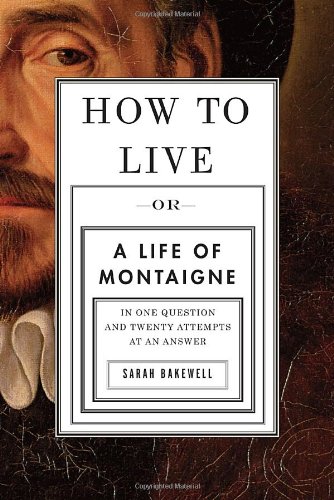
We begin a new year of discussions with a book likely to make you question the tradition of making New Year's resolutions: Sarah Bakewell's How to Live--Or--A Life of Montaigne in One Question and Twenty Attempts at an Answer.

Michel Eyquem de Montaigne, a Renaissance nobleman, public official, and winegrower, wondered about such things as how to get along with people and how to adjust to the loss of someone you love--essentially, how to live. He explored these questions in a new form of writing for the time that he called essays, meaning attempts at understanding. He gave these digressive and personal essays titles like Of Friendship, How We Laugh and Cry for the Same Thing, Of Thumbs, How Our Mind Hinders Itself, Of Experience.

Sarah Bakewell discovered Montaigne serendipitously, as the only book available in English to while away the time on a train ride in Budapest. Her biography conveys her great affection and admiration for Montaigne, telling the story of his colorful life through the questions he posed and the answers he and his readers over the past four centuries have found in his companionable, witty, and wise writing.

Bakewell says in her Acknowledgements that discovering Montaigne's essays taught her "the Montaignean truth that the best things in life happen when you don't get what you think you want." If this is true, then what does this mean for those often guilt-inducing New Year's resolutions and the bigger question, always hovering over all we do, of how to live? In an article Bakewell wrote for The Independent that was published January 1, 2010, she suggests that Montaigne would tell us not to make resolutions. "He did think, though, that valuable lessons could be learned from looking over a life and taking a longer perspective. Instead of clean breaks and new intentions, what Montaigne sought in his past experience was greater self-understanding. There would always be puzzling areas, but he tried to become familiar with his weaknesses so as to work around them. . . . . This is very different from making resolutions. It does not mean rejecting past actions, but accepting and even embracing them in order to become what Montaigne calls 'wise at our own expense.'"

We hope you will join the discussion as we take Montaigne as our guide: Tuesday, January 3, at 6:30 p.m. at Main Library; Thursday, January 19, at 11:00 a.m. at West Ashley Branch Library; and here on the blog.